Tuesday, 19 March 2013

ROSEDALE and ROSEDALE IRONWORKS.

 
ROSEDALE IRONWORKS.
 
This is Bank Top where iron ore was tipped into the kilns from above to be roasted to drive off water and carbonic acid gas. This process is known as calcinations and dramatically reduces the weight of the ironstone which in turn reduces transport costs. Much of the masonry of the kilns survives but all the shutters and ironwork have long gone.
 
 
Calcine Kilns at Rosedale.


ROSEDALE.
 
Rosedale is a valley located in the centre of the North Yorkshire Moors National Park in North Yorkshire, England. The nearest town is Pickering located some 10 miles to the south. Rosedale is surrounded by some of the most beautiful moorland in England. Today Rosedale only has a very small number of people involved in farming. Rosedale is  very popular with walkers.


Tuesday, 12 March 2013

BARN OWL.


I took this picture way back in 2010 when I was visiting Yorkshire Wildlife Park nr Doncaster, South Yorkshire, England. The owl was perched on it`s keepers gloved hand.
The Barn Owl is the most widely distributed species of owl, and one of the most widespread of all birds. It`s scientific name is Tyto Alba. The Barn Owl is a pale, long-winged, long-legged owl with a short squarish tail.
I shall be showing some more of the animals I photographed at a later date. If you want to know more click on this link to go to there web site, it iswww.yorkshirewildlifepark.com

Wednesday, 6 March 2013

LINCOLN (part two ).

Continued from part one.

THE GUILDHALL AND STONEBOW.


A real Lincoln landmark, this lovely Tudor building is situated above the Stonebow Arch, where the southern gate to the old roman city once stood. The Guildhall was finished in 1520, and is the official home of the mayor of Lincoln. The Stonebow replaced the roman gateway at the southern extremity of the colonia, or roman town. The name Stonebow comes from Stennibogi, a Norse word meaning stone arch. Of particular note is the south face, adorned with lovely carved statues and grotesques - carved heads of mythical creatures. The mote bell, struck in 1371, is still used to signal council meetings. The old debtors prison on this site has been turned into civic insignia room, which houses a variety of historic civic treasures, including a sword given by Richard II and Charles I`s mace of office. In the Medieval period the Lincoln guilds met here to administer Lincoln`s city government. This guild government was called the Burwarmote. This quasi-trade body was then replaced by a city council. For many years the city goal was located at the guildhall, with dungeons for felons, and a small debtor`s prison at street level.

 
HIGH BRIDGE AND THE GLORY HOLE.


The high bridge in Lincoln, England is the oldest bridge in the United Kingdom which still has buildings on it. It was built in the 12th century and the oldest building dates from the 14th century. Bridges like this were common in the middle ages, the best known being London Bridge, but most have long since been demolished because of their obstruction to the river flow and to shipping. The Glory Hole is the name given by generations of boaters to the high bridge in Lincoln. It has a narrow and crooked arch which sets a limit on the size of boats using the river Witham and going from Brayford Pool, at the start of Foss Dyke, to Boston and the sea. Since the 14th century the bridge has contributed to floods in Lincoln and after any heavy rain the bridge is virtually unnavigable, which may be why it got it`s name. The two characters to the left of my photo are my brother in law Barrie and my mate Darren.
 
Closer view of the Glory Hole.
 
 
OBSERVATORY TOWER.
 
 
Lincoln Castle was built by William the Conqueror in 1068 on a defencive site occupied since Roman times. To enlarge the site for the new castle 166 houses were demolished. It is one of only two castles in Britain built with two mottes. A square tower was built on the smaller motte in the 14th century and in Victorian times an observatory (above) was added. The two mottes were enclosed by immense 12th century walls. The castle acted as the city`s prison between 1787 and 1878 with coffin-like pews in the chapel to remind prisoners of their fate and to ensure they could not see each other. I took this picture from outside the castle grounds.
 
 
EXCHEQUER GATE.
 
 
Located at the Cathedral end of Castle Hill, this is where tenants who rented property from the church came to pay their rents. A chequered cloth was used to aide the counting of the rent monies, and it is from the alternating black and white pattern of the cloth that we get the word exchequer. The gate was built in the 14th century, and probably acted as the main, ceremonial access point to the Cathedral Close. To call this lovely building a gate does not convey a sense of how grand the structure really is . There are actually three gates, or passages through exchequer gate to the cathedral precinct, two smaller postern gates flank a pointed central arch, vaulted with brick. Octagonal turrets flank the central arch, and the whole structure is topped with battlements. Above the arches are two further floors of rooms, which were at one time let as dwellings. The origin of the building is uncertain, but tradition holds that it was constructed during the reign of Edward I.
 
 
ST MARY CHURCH.


St Mary-Le-Wigford Church to give it it`s proper title dates to the late Saxon period, with a tall tower that may date to 980AD, and an early English Nave. The bulk of the architecture is early 13th century. Set into the wall of the West Tower (not clearly visible in my photo, to the right of the main door) is a Roman grave stone which was later used as a dedication tablet to the Saxon founder of the church, a man named Eirtig. Eirtig wrote from bottom to top on this tablet, inviting readers to raise their eyes to the heavens above. The Latin text is much worn, but appears to translate as - Eirtig had me built and endowed to the glory of Christ and st Mary. Inside the church their is an impressive memorial a 1618 tomb cover to Sir Thomas and Lady Granthem. The font is 14th century and has some intricate carving detail. Outside the west tower is the condult (not in my photo) a scheduled ancient monument that shows where a medieval channel once brought fresh water to the lower city.
 
 
ELLIS WINDMILL.
 
 
This wonderful mill is located on Mill Road, Lincoln UK, so called due to the nine windmills that formally faced west over the steep slopes of the Lincoln Edge. Ellis`s mill is now the sole survivor of these mills. Ellis mill is an excellent surviving example of a small tower mill and dates from 1798. There has been a mill on this site from at least the middle of the 17th century. The first recorded owner of the mill was a wealthy landowner named Anthony Meres. It went through a succession of owners until December 1894 when John Ellis bought the mill for £250. He died in 1920, but his wife and son successively retained ownership until 1973. The mill was working until the 1940`s when the machinery was removed and it fell into dereliction. Tragedy struck further when a fire finally destroyed all of the remaining woodwork in 1974. The Lincoln Civic Trust acquired the mill in march 1977 and set about it`s restoration. First, the tower was cleaned and the floors and cap re-constructed, it was then necessary for replacement parts to be found that fitted the dimensions of the existing tower. The cap mechanism was acquired from Subscription Mill in Sturton-by-Stow, the stones and drives from Enos Mill at Toynton-All-Saints. The sails and fantail were built and erected by Thompson and Co, millwrights from Alford. The mill was finally completed in 1980 and on Sunday 26th April 1981, Ellis Mill ground it`s first flour for 40 years. The mill is still in full working order and provides flour, subject to sufficiently windy days!. The mill is now managed by Lincolnshire County Council but would not run without the group of devoted museum volunteers who help maintain, staff and promote the site. After working for 28 years one of the sails at Ellis Mill is currently being replaced, windmill sails usually last for about 25 years so the current sails have stood the test of time well. The opposite sail has also been temporarily removed (see my photo) to keep the mill mechanisms balanced. As was standard practise in such circumstances in the past, the mill will run on two sails until the new sail is ready to be fitted.
 
 
Closer view of the mills door.


Thursday, 28 February 2013

LINCOLN (part one ).

Lincoln is a cathedral city and county town of Lincolnshire, England. It is approximately 27 miles from where I live in Worksop. These are a few of the photographs I have taken while visiting this lovely city.

LEIGH-PEMBERTON HOUSE, castle square.


This large timber framed merchant`s house situated in castle square, Lincoln, dates from around 1543. It is thought to have been a pub, possibly the Ironmongers Arms in 1666. From 1899 - 1979 it was a bank branch and it was The National Provincial Bank who extensively restored the building in 1929, later it became The National Westminster Bank following national provincial`s merger with the Westminster bank in 1968. It is now a Tourist Information Office.
 
 
JEWS HOUSE, steep hill.
 
 
Jews house dates from 1158 and is a fine example of Norman Domestic Architecture with a rich ornamental doorway and chimney. It is reputed to be the oldest domestic building in Britain. Originally it had three segmented arches for shop fronts since replaced by modern insertions. In the middle ages Lincoln had a flourishing Jewish community with money lenders, traders and merchants. The people within this community were amongst the richest and most influential citizens of Lincoln and the building reflects the affluence of the Jewish communities traders of the time. This is possibly one of the reasons the Jews were expelled from Lincoln in 1290. It was once the residence of Bellaset of Wallingford who was executed for forgery in 1290.
 
 
JEWS COURT, steep hill.
 
 
Jews court essentially dates back to the 17th and 18th centuries. Some traditions hold it to be a 12th century synagogue, with a niche in the east wall considered to be the ark, documentary sources confirm that there was a synagogue against the Jews house until the expulsion of the Jews in 1290, but this may have actually been located to the rear. From 1800 the property was divided into four tenements and only just escaped demolition in late 1920`s slum clearance.
 
 
THE CROOKED HOUSE, michaelgate


This close studded timber framed building under built in brick dates from 1500. The south gable rests on a stone dwarf wall. It was renovated and refenestrated in 1935, exposing the timber beams and brickwork, it is also sometimes known as the bendy house.
 
 
ST MARY MAGDALENE CHURCH.
 
 
The church of St Mary Magdalene stands at the crossroads at the heart of the cathedral quarter, it is the parish church for the Bail and Steep Hill and for the Cathedral. The original Saxon church was knocked down to build the cathedral. The parishioners were later given the present church site on the north side of the exchequer. The exchequer was a medieval shopping centre and this began the long connection of St Mary Magdalene`s with the retail activity in the bailgate area. Records show that there were two shop units in the crypt below the church accessed from a doorway in the wall facing the exchequer. The outline of the blocked south doorway can still be seen in the stonework. Today St Mary Magdalene`s is home to a lively, all age congregation which actively engages with the community on bailgate and steep hill.
 
 
THE HARLEQUIN, steep hill.
 
 
The Harlequin, only a stones throw away from Lincoln`s first theatre which opened in Drury Lane in 1744, was a regular drinking haunt of the theatre folk. Although looking like a typical late 15th century timber-framed building some of the interior dates back to the 12th century. Although still sporting the Harlequin sign the building is now an antiquarian and second-hand bookshop.
 
 
To be continued.


Wednesday, 20 February 2013

THE GREEN KNIGHT STEAM TRAIN.

Ex BR Standard Class 4MT 4-6-0 locomotive No 75029 built at Swindon Works in 1954 or 1956.
The Green Knight travels between Pickering and Whitby on the North Yorkshire Moors railway.


The Green Knight waiting to depart Grosmont station.


Saturday, 9 February 2013

BEGGARS BRIDGE----GLAISDALE.

While on one of are trips to the North Yorkshire Moors we decided to take a look at the beggars bridge, it`s  one of those places that if you don`t know it`s there you can easily drive past it without knowing, as it is between a railway bridge and a road bridge. This beautiful humpbacked bridge is in Glaisdale spanning the river Esk. There is a lovely romantic legend regarding this bridge. It goes like this and I quote from the Insight guide to the North Yorkshire Moors book, it`s the courtship of the squires daughter by local farmhand Thomas Ferris. Told by the squire that his daughter wasn`t going to marry a beggar, Tom vowed to make his fortune. The night before he sailed from Whitby on this mission, a flood on the Esk, at the time crossed only by a ford or stepping stones, prevented him bidding farewell to his sweetheart. Eventually returning rich -the fruit of piracy some say - he not only married the girl but built a bridge for future lovers. There is almost certainly some truth in the tale, for a 17th - century Hull shipowner, Thomas Ferris, left substantial bequests to Glaisdale Parish Church, and his initials, with the date 1619, are on the outer upstream parapet of the bridge.


I had to balance on two stepping stones to get this picture. The river Esk is not deep at this point but never the less it would have covered my shoes.


Three silly beggars, me on the left, my mate Daz on the right and the third my brother in law Barrie using my camera to take the picture.


Saturday, 2 February 2013

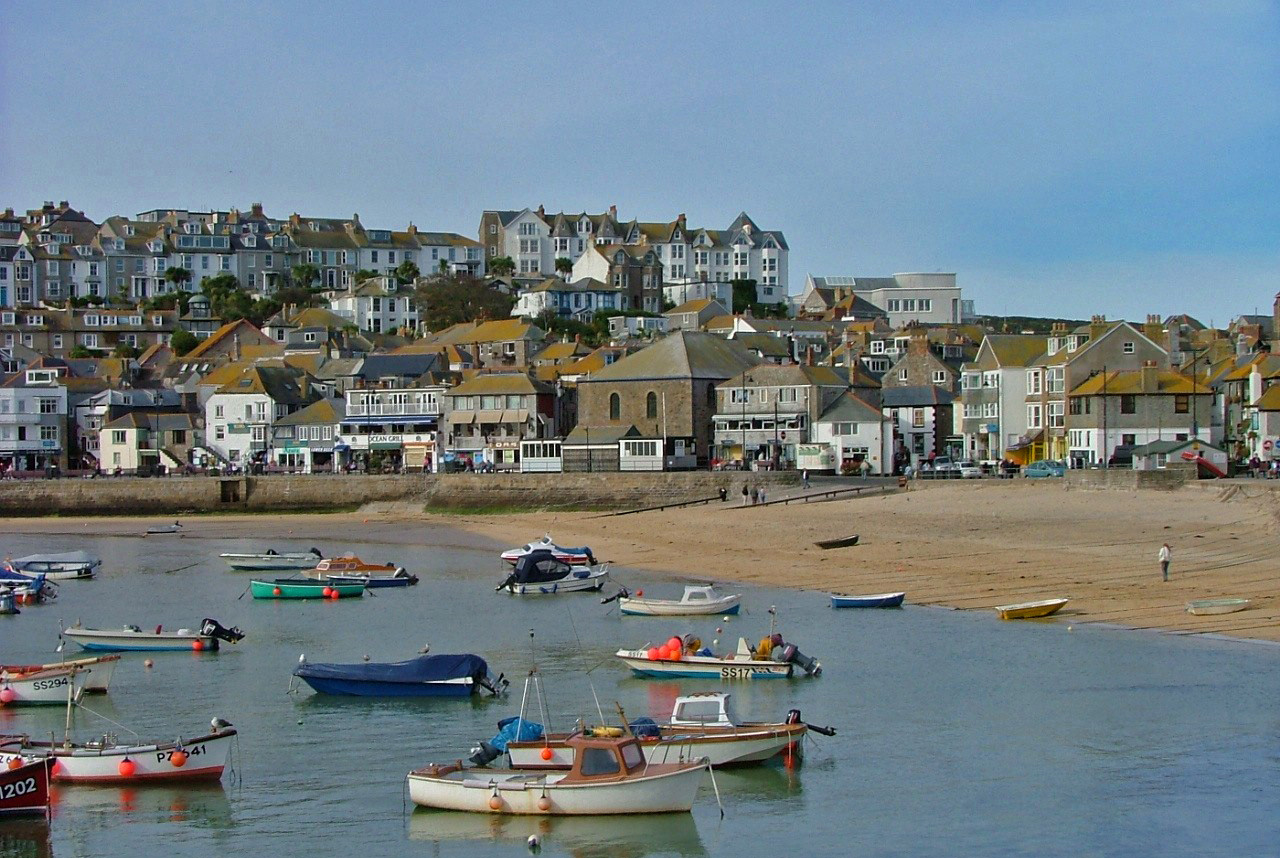
ST IVES (Cornwall ).

St Ives is a seaside town and port in Cornwall, England. In former times it was commercially dependent on fishing, but due to the decline in fishing, St Ives is now primarily a popular holiday resort. St Ives is also well known from the nursery rhyme:-- "AS I WAS GOING TO ST IVES".
 
As I was going to St Ives
I met a man with seven wives
every wife had seven sacks
every sack had seven cats
every cat had seven kits
kits, cats, sacks, wives
how many were going to St Ives.
 
St Ives is situated on the shore of St Ives bay, it`s harbour is sheltered by Smeaton`s Pier. Close to the harbour, it`s streets are narrow and uneven. The town has four beaches,:--Porthmeor a surfing beach, Porthgwidden a small sandy cove, Harbour by the working port and Porthminster which has half a mile of sand.